Ralph Lauren Native American Inspired Fashion
The habiliment company Ralph Lauren released an online advertizement for its RRL line terminal month that drew scathing criticism from Native Americans.
The ad's imagery harked dorsum to the Old West, with henley jerseys and rustic jeans displayed in faded sepia tones. And while one page touted bandanas and "Western-style" shirts, the contrary page showed a Native American sporting a feathered headdress, property a burglarize across his lap.
Another folio depicted a stoic Native American human being with dark skin, braided hair and a Western shirt-and-vest combo.
Critics charged that the ads reduced people, and indeed entire cultures, to mere marketing props. Many called for a boycott. Dr. Adrienne Keene, a postdoctoral researcher and denizen of the Cherokee Nation, wrote in a post for Indian Land Today Media Network that Ralph Lauren had reached a "new depression."
"Ralph Lauren has been doing this my whole life," Ruth Hopkins, a writer in her 30s who lives on the Spirit Lake Tribe reservation in North Dakota, told The Huffington Mail. "He is a repeat offender. Cultural cribbing is apparently his thing."
Post-obit the outcry, the company removed the images from its website and apologized.
The episode neatly summed up an issue in fashion and pop civilisation that has drawn heated debate in recent years. Many people seemingly remain tethered to the idea of a romanticized Erstwhile Due west -- a time of decease and carnage for America's indigenous population.
The "cowboys and Indians" movies of the 1950s did much to solidify these tropes in mod American culture, building on centuries of stereotypes. These films mashed up the traditions of countless tribes indiscriminately, ofttimes depicting Native Americans as primitive, even bloodthirsty brutes. At best, indigenous people were depicted every bit noble savages, piteous characters non notwithstanding corrupted by the "civilized" globe. Meanwhile, the real-life meanings attached to certain items, customs and historical figures got distorted or lost, and white Americans, for the most part, neither knew nor cared.
Model Karlie Kloss wearing a Native American headdress during the taping of the 2012 Victoria'southward Secret Fashion Show in New York. (Photograph credit: AP/Starpix, Amanda Schwab)
Take the war bonnet, a feathered headdress worn past the warriors or leaders of many Native American tribes. Each feather was earned through a sacrifice or an act of valor, making the bonnet a mark of great respect. Simply at the 2012 Victoria's Hush-hush Way Show, supermodel Karlie Kloss strode down the catwalk in panties, a skimpy bra and a massive war bonnet-like headdress. Chanel put headdresses on the runway in 2013, and Pharrell Williams donned one on the cover of Elle Britain in 2014. Each incident was met with swift backfire.
Such cliched images are what many Native Americans in the mode industry want to transcend.
"Mass gild thinks that way," said Bethany Yellowtail, a 26-year-old mode designer and member of the Crow and Northern Cheyenne tribes. "They retrieve of teepees and headdresses and feathers."
Raised in Montana on the Crow Indian Reservation, Yellowtail wants to bring actuality to indigenous fashion with her line B.Yellowtail, which volition be released in spring. Her wearing apparel are modern takes on the classic designs of her civilisation, adapting the piece of work of her ancestors to the 21st century -- for instance, designs based on the beadwork of her great-grandmother, who lived in the 19th century.
"Our original designs were purposeful," she said. "The colors, the designs -- everything has a specific meaning and a spirit connected to it."
Bethany Yellowtail'south "Old style floral elk tooth dress" on the track at the Santa Fe Indian art market. (Image credit: Lehi Sanchez)
Patricia Michaels, a 48-year-old Native American fashion designer who appeared on Bravo's "Project Rails" in 2013, told HuffPost that she doesn't consider it her place to law what people can or tin can't use in their designs. It should come down to thoughtfulness and taste, she said, calculation that if the non-Native American designers who have gotten in trouble in the past had simply collaborated with Native American designers who know the culture, everyone would accept benefited.
"I wouldn't take the Pope's lid and put it on the runway," said Michaels, who is based in New Mexico. "I think that'due south where taste comes in, as far equally a designer. Exercise you lot really want to put a state of war bonnet on a female model? If you're going to be distasteful and have no regard for somebody's culture, it's shameful."
When Michaels describes her designs, it'due south articulate that everything has a pregnant. Her "Elk Antler Cape" strives to portray the beauty and grace of ethnic hunters and the animals that give their lives. An "Ink Baste Meridian" on silk charmeuse represents contaminants invading once-pure waters. A flowing, hand-painted organza skirt symbolizes the years that Michaels' ancestors spent observing and preserving nature.
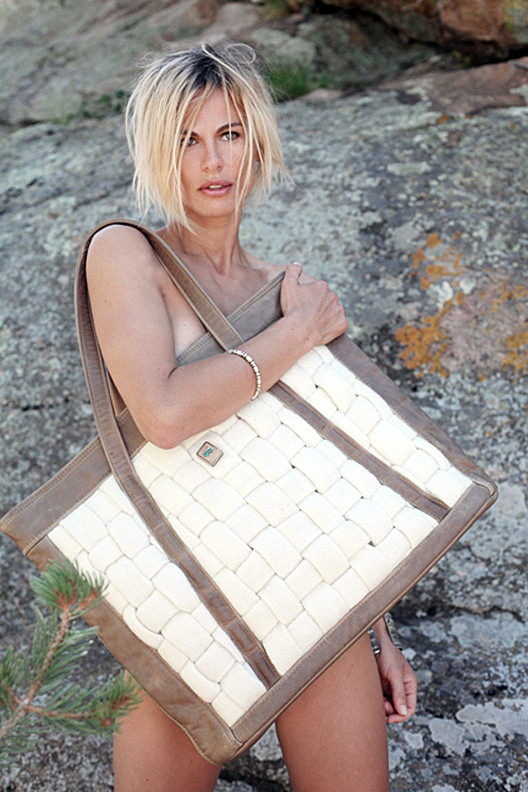
Patricia Michaels' hand-felted wool purse is an homage to Navajo weavers. (Epitome credit: curryimages)
Meanwhile, Ralph Lauren's "Pawnee jacket" -- an item that appeared in the controversial RRL ads concluding month, and one that shares a name with a Midwestern tribe -- was described in the advertising copy as "a faithful wool/nylon jacket modeled afterward a 1930s sporting coat." It'south unclear if any Pawnee people had a part in designing the jacket. A search for "Pawnee" on the Ralph Lauren website now yields no results.
The famed designer behind his eponymous make built his manner empire on images of archetype Americana, clothes that evoke the idyllic American dream. Many of his brand's designs succeed in that -- from preppy polos to denim workwear -- and his Navajo prints of the 1980s popularized many indigenous patterns.
Simply where'southward the line between celebration and appropriation? Terminal year, Ralph Lauren released another collection that raised some eyebrows. It had lots of Native American imagery, similar headdresses and totem poles.
A representative for the Ralph Lauren company declined to comment for this article. Lauren himself, though, addressed his love for Native American aesthetics in an interview with the Associated Printing final June. The designer reflected on his years growing up in the Bronx, New York.
"I grew upwardly inspired by America, inspired by the Westward, inspired by the Adirondacks, inspired by African-Americans, soldiers -- life that I saw -- the Native Americans," Lauren told the AP. "I saw a earth that was different, and I was inspired."
The Native American aesthetic is clearly a big function of Lauren's life. His Double RL Ranch in Colorado is chock-full of tents and artifacts, and there's even a decorative vintage photo of a nameless Native American child. After the ranch was featured on "The Oprah Winfrey Evidence" in 2011, Dr. Jessica Metcalfe, writing at the web log Across Buckskin, dubbed the photograph the "ultimate form of appropriation."
"That little daughter is someone," Metcalfe wrote at the time. "She'southward someone'due south daughter, sister, antie, niece, mother, cousin, granddaughter, grandmother."
There'due south a pervasive idea that Native Americans are a thing of the past, said Kim TallBear, a professor of anthropology and Native American and indigenous studies at the University of Texas at Austin. The idea that Native Americans no longer be makes it easier for lodge to ignore their voices. Cultural representations of Native Americans are ever focused on the past, she said, equally seen in sports franchises like the Cleveland Indians and Washington's NFL squad.
"In that location's a national delusion that we're all dead and vanished," said TallBear, a member of the Sisseton Wahpeton Oyate in South Dakota. "We are gimmicky, living people."
0 Response to "Ralph Lauren Native American Inspired Fashion"
Post a Comment